
Specific Process Knowledge/Lithography/SU-8: Difference between revisions
No edit summary |
|||
| Line 4: | Line 4: | ||
SU-8 is an epoxy based negative i-line photoresist with a high contrast. More then 10:1 aspect ratio imaging with vertical sidewalls is one of the widely used properties of this resist. It also has high chemical, plasma and temperature resistance after curing which makes it well suited for permanent use applications. | SU-8 is an epoxy based negative i-line photoresist with a high contrast. More then 10:1 aspect ratio imaging with vertical sidewalls is one of the widely used properties of this resist. It also has high chemical, plasma and temperature resistance after curing which makes it well suited for permanent use applications. | ||
<span style="color:red">'''Note:''' Since the SU-8 is epoxy-based, the user is required to take the mandatory epoxy course "Personlig sikkerhed ved arbejde med epoxy". Registration to this course can be found on Portalen under: [https://www.inside.dtu.dk/en/medarbejder/hr-og-arbejdsmiljoe/kompetenceudvikling/kursusoversigt_overside/kursusoversigt/arbejdsmiljoe-og-beredskabskurser/epoxy-kursus?fs=1 Arbejdsmiljø kurser]</span> | |||
In the cleanroom the SU-8 2000 product line is widely used, where the '''SU-8 2005''', '''SU-8 2035''', and '''SU-8 2075''' are supplied by Nanolab. Other | In the cleanroom the SU-8 2000 product line is widely used, where the '''SU-8 2005''', '''SU-8 2035''', and '''SU-8 2075''' are supplied by Nanolab. Other resist formulations can be used, but has to be ordered by the user. | ||
Process recommendations: | '''Process recommendations:''' | ||
* a standard process consist of spinning, soft bake, exposure, post-exposure bake and development. Please notice that the entire process must be done continuously, meaning that it is not recommendable to spin the resist and then wait until the next day before exposing | * a standard process consist of spinning, soft bake, exposure, post-exposure bake and development. Please notice that the entire process must be done continuously, meaning that it is not recommendable to spin the resist and then wait until the next day before exposing | ||
* exposure using radiation above 350 nm is recommended | * exposure using radiation above 350 nm is recommended | ||
* Controlled soft and post-exposure bakes are recommended and must be optimized for the specific application, but baseline parameters which can be used as a starting point will be given | * Controlled soft and post-exposure bakes are recommended and must be optimized for the specific application, but baseline parameters which can be used as a starting point will be given | ||
You can also take a look at a Ph.D thesis on the topic that you can find in Process2Share: http://process2share.danchip.dtu.dk/index.php/Specific_Process_Knowledge/Photolithography/SU8#Reports] | You can also take a look at a Ph.D thesis on the topic that you can find in Process2Share: http://process2share.danchip.dtu.dk/index.php/Specific_Process_Knowledge/Photolithography/SU8#Reports] | ||
Revision as of 16:24, 30 January 2023
Resist description
SU-8 is an epoxy based negative i-line photoresist with a high contrast. More then 10:1 aspect ratio imaging with vertical sidewalls is one of the widely used properties of this resist. It also has high chemical, plasma and temperature resistance after curing which makes it well suited for permanent use applications.
Note: Since the SU-8 is epoxy-based, the user is required to take the mandatory epoxy course "Personlig sikkerhed ved arbejde med epoxy". Registration to this course can be found on Portalen under: Arbejdsmiljø kurser
In the cleanroom the SU-8 2000 product line is widely used, where the SU-8 2005, SU-8 2035, and SU-8 2075 are supplied by Nanolab. Other resist formulations can be used, but has to be ordered by the user.
Process recommendations:
- a standard process consist of spinning, soft bake, exposure, post-exposure bake and development. Please notice that the entire process must be done continuously, meaning that it is not recommendable to spin the resist and then wait until the next day before exposing
- exposure using radiation above 350 nm is recommended
- Controlled soft and post-exposure bakes are recommended and must be optimized for the specific application, but baseline parameters which can be used as a starting point will be given
You can also take a look at a Ph.D thesis on the topic that you can find in Process2Share: http://process2share.danchip.dtu.dk/index.php/Specific_Process_Knowledge/Photolithography/SU8#Reports]
Pretreatment
- To dehydrate the surface, bake in 250C oven at least 30 min, the longer the bake the better. Baking overnight is recommended.
- Another dehydration step can be done in the HMDS oven using recipe 9. This does not expose the wafers to HMDS but instead makes a bakeout at reduced pressure
Spinning
SU-8 resist is designed to produce low defect coatings over a very broad range of films thickness.
Spin Coater: RCD8 is dedicated to spin all SU-8 resist formulations, but one of the manual spin coaters can also be used.
To keep clean room safe and odor free during the spinning please follow the following simple rules:
- Always use point exhaust above the place you handle the resist.
- When you move the wafers to the dedicated hot plates always carry them in a closed container.
The recommended coating condition:
- Dispense manually from bottle/syringe for the thin resists or use a syringe dispense system for the thick resists.
- Use static dispense; approximately 1 ml of SU-8 per inch substrate diameter.
- For SU-8 layers thicker then 100 um use two/step spin coating procedure:
- spread cycle 500rpm, 100rpm/s, 5 sec following by
- thickness definition cycle with the final spin speed
- layer uniformity of the thick films can be improved by using a rotation cover (Gyrset), but remember the speed limitation 3000rpm.
- For SU-8 layers thinner then 10um the spread cycle can be omitted to improve the uniformity of the films.
Here are the spinning curves for SU-8 2002 and SU-8 2005 (for the old KS Spinner). Spinning curves for SU-8 2002 and 2005.
- A rotation cover (Gyrset) can be also used in case you will spin less than 1um resit
- 3000rpm, 300rpm/s, 30sec with gyrset gives appx. 850nm with SU-8 2002 (the test done by Thomas Buss from Nanotech).
- Another way to get a thinner layer is dilute SU-8 2002 in cyclopentanone solution (25ml SU-8 in 80ml cyclopentanone) gives 120nm layer with 7000rpm spinning (the test done by Irene Fernandez-Cuesta and Nimi Gopalakrishnan from Nanotech).
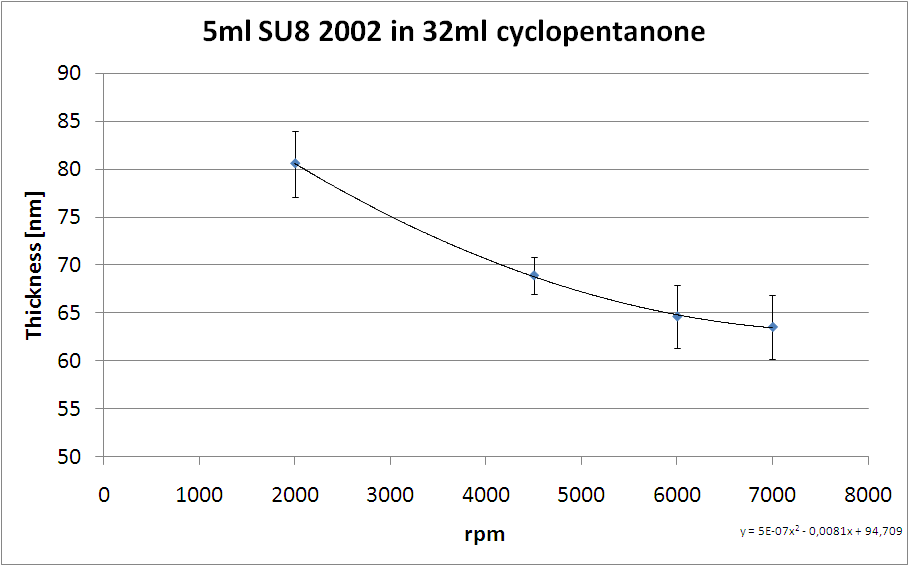
- To achieve a thickness between 80nm and 60nm dilute SU-8 2002 in cycopentanone in proportion 5ml SU-8 to 32 ml cyclopentanone. This test is done by Luca Pietrobon from Nanotech. See the spinning curves here. Diluted SU8 2002.
Baking
SU-8 baking can be divided in 2 steps: soft bake step after spinning and post exposure bake after exposure.
The goal of the soft bake step is reducing the amount of solvent in the photoresist layer. The heat application leads to the solvent diffusion to the resist surface and its evaporation. The soft bake step can be done on SU-8 hotplates, marked Hotplates 1 and 2 in LabManager, and usually done in one or two steps with 5-8 deg/min temperature ramp between steps. The soft bake temperature typically is between 20 and 110 C and the soft bake time depends on the film thickness. After soft bake, the resist should be firm to the touch (not sticky) in order to be used in the exposure tools.
The goal of the post exposure bake is increasing the polymerization reaction even the polymerization can in principle take place at room temperature. The post exposure step can be done at the same hotplates, as the soft bake step, with the temperature range between 20 and 120C and with temperature ramping 5-8 deg/min. It is important to do the post exposure bake immediately after exposure to limit photoinitiator diffusion into non-exposed areas.
Exposure
The exposure step is usually done in near UV-radiation at aligners system which blocks the wavelengths below the i-line (365nm wavelength). KS Aligner and Aligner: MA6-2 both have i-line filters. Aligner: Maskless 01 (MLA1) has a 365nm source. Exposure on Aligner: Maskless 02 (MLA2) using the 375nm source works, but needs a higher dose, and the resist thickness is limited on this tool.
Duration of the UV-exposure depends of resist thickness, but notice that if the UV exposure becomes long then the heating at the interface with the mask can cause formation of hard skin at the surface of SU-8 so called T-topping phenomena. The the main rule is if the dose of the exposure exceeds 250-300 mJ/cm2 it is recommended to do a multiple exposure instead and have a waiting time between the steps to allow the resist cool down.
Developing
Developing of the SU-8 patterns is done in the special developing station placed in cleanroom C-1 at Danchip. Under developing the substrates are immersed in Propylene Glycol Methyl Ether Acetate (PGMEA) first in a bath marked "First" and after in a bath marked "Final".
The development time is dependent on the layer thickness. Minimum development time: 1 min per 20µm in "First".
After the development the substrate must be rinsed with Isopropyl Alcohol (IPA) on both side for 30 sec. White traces during rinsing indicate incomplete development of SU-8.
Finally the substrates are dried in air in the drying box or with a nitrogen gun.
Phd. work on the topic
PhD dissertations
- PhD Thesis by Thomas Anhøj (February 2007) on process optimization of 40µm thick SU-8 25 for lab-on-a-chip.