
Specific Process Knowledge/Wafer cleaning/7-up & Piranha: Difference between revisions
| (38 intermediate revisions by 4 users not shown) | |||
| Line 1: | Line 1: | ||
'''Feedback to this page''': '''[mailto: | '''Feedback to this page''': '''[mailto:labadviser@nanolab.dtu.dk?Subject=Feed%20back%20from%20page%20http://labadviser.danchip.dtu.dk/index.php/Specific_Process_Knowledge/Wafer_cleaning/7-up click here]''' | ||
'''Unless anything else is stated, everything on this page, text and pictures are made by DTU Nanolab.''' | |||
'''All links to Kemibrug (SDS) and Labmanager Including APV requires login.''' | |||
'''All measurements on this page has been made by Nanolab staff.''' | |||
==Cleaning of wafers or masks== | ==Cleaning of wafers or masks== | ||
Cleaning of wafers or masks | Cleaning of wafers or masks can be done in dedicated baths ("Wafer Cleaning" and "Mask Cleaning" respectively). They are both located inside "Wet bench 03: Wafer and mask cleaning" and both contain concentrated sulfuric acid to which a little ammonium persulfate is added before use. This creates very reactive peroxide species that remove organic traces efficiently. Historically this mixture has also been referred to as "7-Up" because it fizzes and bubbles similar to the 7-Up beverage. | ||
Always use one of these after KOH etch or hot phosphoric acid etch to remove alkali ions before further processing. 7-up and Piranha | Samples not allowed or not compatible with these baths can be cleaned manually in a beaker filled with the so called "Piranha" mixture using one of the acids/bases fume hoods. This mixture consists of concentrated sulfuric acid and hydrogen peroxide forming very aggressive and reactive peroxide species (as in 7-Up) which is very effective at removing organic contaminants and to a certain extent some metal ions. | ||
Always use one of these cleaning procedures after KOH etch or hot phosphoric acid etch (Nitride etch) to remove alkali ions before further processing . 7-up and Piranha should only be used '''AFTER''' stripping resist by other means (see [http://labadviser.nanolab.dtu.dk/index.php/Specific_Process_Knowledge/Lithography/Strip Resist strip] page). Cleaning samples with resist coatings or significant amounts of other organic substances can be very dangerous, because 7-Up and Piranha are so aggressive. '''These solutions are intended for removing TRACES of organic matter. Adding large amounts of organics can lead to explosive reactions!''' | |||
User manuals, risk assessments and contact information can be found on the equipment Info-pages in LabManager:<br> | |||
[ | *[http://labmanager.dtu.dk/function.php?module=Machine&view=view&mach=383 Wafer Cleaning Info page in LabManager] | ||
*[http://labmanager.dtu.dk/function.php?module=Machine&view=view&mach=382 Mask Cleaning Info page in LabManager] | |||
*[http://labmanager.dtu.dk/function.php?module=Machine&view=view&mach=368 Fume hood 01 Info page in LabManager] | |||
*[http://labmanager.dtu.dk/function.php?module=Machine&view=view&mach=369 Fume hood 02 Info page in LabManager] | |||
*[http://labmanager.dtu.dk/function.php?module=Machine&view=view&mach=508 Fume Hood 12 (Standard clean) Info page in LabManager] | |||
'' | <gallery widths=200px heights=200px> | ||
WaferClean.jpg|Wafer clean' bath in cleanroom D3 | |||
MaskClean.jpg|Mask clean' bath in cleanroom D3 | |||
FH01-02.jpg|Fume hood 01 and 02 in cleanroom D3 | |||
FH12.JPG|Fume Hood 12 (Standard clean) in cleanroom B1 | |||
</gallery> | |||
===Comparing | ===Comparing Wafer/Mask Cleaning baths and Piranha clean=== | ||
{| border="2" cellspacing="0" cellpadding="4" align="left" width="570pt" | {| border="2" cellspacing="0" cellpadding="4" align="left" width="570pt" | ||
|-style="background:silver; color:black" | |-style="background:silver; color:black" | ||
! | ! | ||
! | ! Wafer Cleaning | ||
! | ! Mask Cleaning | ||
! Piranha | ! Piranha (fume hood) | ||
|- | |- | ||
|-style="background:WhiteSmoke; color:black" | |-style="background:WhiteSmoke; color:black" | ||
|'''General description''' | |'''General description''' | ||
| | | | ||
Cleaning of wafers using the dedicated | Cleaning of wafers using the dedicated bath in Wet bench 03. | ||
| | | | ||
Cleaning of masks using the dedicated | Cleaning of masks using the dedicated bath in Wet bench 03. | ||
| | | | ||
Cleaning of wafers using a beaker in | Cleaning of wafers using a beaker in a fumehood in cleanroom D3. Used for glass wafers or wafers with metal or other materials that you are not allowed to put in the Wafer or Mask Cleaning bath. | ||
|- | |- | ||
|-style="background:LightGrey; color:black" | |-style="background:LightGrey; color:black" | ||
|'''Chemical solution''' | |'''Chemical solution''' | ||
|98% | |Sulfuric acid (98%) and ammonium persulfate | ||
|98% | |Sulfuric acid (98%) and ammonium persulfate | ||
|98% | |Sulfuric acid (98%) and hydrogen peroxide (30%) in the ratio 4:1. First add H<sub>2</sub>SO<sub>4</sub> into a glass beaker then add H<sub>2</sub>O<sub>2</sub><sup>{{fn|1}}</sup>. | ||
|- | |- | ||
|-style="background:WhiteSmoke; color:black" | |-style="background:WhiteSmoke; color:black" | ||
|'''Process temperature''' | |'''Process temperature''' | ||
| | |80°C | ||
| | |80°C | ||
|~70 | |~70-80°C. The chemicals will heat up to working temperature during mixing, '''therefore be careful!'''<sup>{{fn|1}}</sup>. | ||
|- | |- | ||
|-style="background:LightGrey; color:black" | |-style="background:LightGrey; color:black" | ||
| Line 73: | Line 87: | ||
*Wafers with Cr | *Wafers with Cr | ||
| | | | ||
All materials (in beaker). | All materials allowed in cleanroom (in beaker). | ||
|- | |- | ||
|-style="background:LightGrey; color:black" | |-style="background:LightGrey; color:black" | ||
| Line 95: | Line 109: | ||
|} | |} | ||
{{fnb|1}} In preparing a solution involving an acid, always add the acid last. The exception to this rule is Piranha, in which case you add H<sub>2</sub>O<sub>2</sub>, which is a very strong | <br clear="all"/> | ||
{{fnb|1}} '''In preparing a solution involving an acid, always add the acid last. The exception to this rule is Piranha, in which case you add H<sub>2</sub>O<sub>2</sub>, which is a very strong oxidant, to H<sub>2</sub>SO<sub>4</sub>, which is a very strong acid. This is done because it is potentially explosive and at the very least will cause the solution to become very warm.''' | |||
Latest revision as of 07:50, 14 October 2025
Feedback to this page: click here
Unless anything else is stated, everything on this page, text and pictures are made by DTU Nanolab.
All links to Kemibrug (SDS) and Labmanager Including APV requires login.
All measurements on this page has been made by Nanolab staff.
Cleaning of wafers or masks
Cleaning of wafers or masks can be done in dedicated baths ("Wafer Cleaning" and "Mask Cleaning" respectively). They are both located inside "Wet bench 03: Wafer and mask cleaning" and both contain concentrated sulfuric acid to which a little ammonium persulfate is added before use. This creates very reactive peroxide species that remove organic traces efficiently. Historically this mixture has also been referred to as "7-Up" because it fizzes and bubbles similar to the 7-Up beverage.
Samples not allowed or not compatible with these baths can be cleaned manually in a beaker filled with the so called "Piranha" mixture using one of the acids/bases fume hoods. This mixture consists of concentrated sulfuric acid and hydrogen peroxide forming very aggressive and reactive peroxide species (as in 7-Up) which is very effective at removing organic contaminants and to a certain extent some metal ions.
Always use one of these cleaning procedures after KOH etch or hot phosphoric acid etch (Nitride etch) to remove alkali ions before further processing . 7-up and Piranha should only be used AFTER stripping resist by other means (see Resist strip page). Cleaning samples with resist coatings or significant amounts of other organic substances can be very dangerous, because 7-Up and Piranha are so aggressive. These solutions are intended for removing TRACES of organic matter. Adding large amounts of organics can lead to explosive reactions!
User manuals, risk assessments and contact information can be found on the equipment Info-pages in LabManager:
- Wafer Cleaning Info page in LabManager
- Mask Cleaning Info page in LabManager
- Fume hood 01 Info page in LabManager
- Fume hood 02 Info page in LabManager
- Fume Hood 12 (Standard clean) Info page in LabManager
-
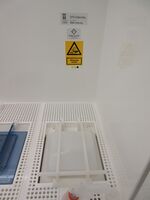
 Wafer clean' bath in cleanroom D3
 -
 Mask clean' bath in cleanroom D3
 -
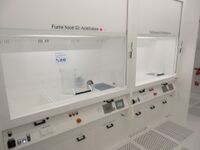 Fume hood 01 and 02 in cleanroom D3
 -
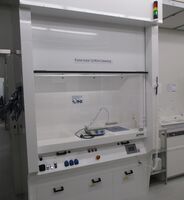 Fume Hood 12 (Standard clean) in cleanroom B1


Comparing Wafer/Mask Cleaning baths and Piranha clean
| Wafer Cleaning | Mask Cleaning | Piranha (fume hood) | |
|---|---|---|---|
| General description |
Cleaning of wafers using the dedicated bath in Wet bench 03. |
Cleaning of masks using the dedicated bath in Wet bench 03. |
Cleaning of wafers using a beaker in a fumehood in cleanroom D3. Used for glass wafers or wafers with metal or other materials that you are not allowed to put in the Wafer or Mask Cleaning bath. |
| Chemical solution | Sulfuric acid (98%) and ammonium persulfate | Sulfuric acid (98%) and ammonium persulfate | Sulfuric acid (98%) and hydrogen peroxide (30%) in the ratio 4:1. First add H2SO4 into a glass beaker then add H2O21. |
| Process temperature | 80°C | 80°C | ~70-80°C. The chemicals will heat up to working temperature during mixing, therefore be careful!1. |
| Process time | 10 min. | 10 min. | 10 min. |
| Allowed materials |
|
|
All materials allowed in cleanroom (in beaker). |
| Batch size |
1-25 4" or 6" wafers |
1-25 4" or 6" wafers or 1-4 5" masks |
1-5 4" wafer at a time |
| Size of substrate |
4-6" wafers |
4-6" wafers or 5" masks |
All sizes that can fit into the beaker in a dedicated holder |
Note 1: In preparing a solution involving an acid, always add the acid last. The exception to this rule is Piranha, in which case you add H2O2, which is a very strong oxidant, to H2SO4, which is a very strong acid. This is done because it is potentially explosive and at the very least will cause the solution to become very warm.