
Specific Process Knowledge/Cross Contamination
The content on this page, including all images and pictures, was created by DTU Nanolab staff, unless otherwise stated.
Feedback to this page: click here
THIS PAGE IS UNDER CONSTRUCTION
Cross Contamination
As explained for The Process Flow, there are a large variety of cleanroom fabrication and characterization methods that can be combined to create new materials or structures. Some processes are very sensitive to contaminations and equipment cannot always be cleaned easily running a pre-process cleaning step.
For example, contaminations during a thermal oxidation process to grow silicon dioxide (SiO₂) layers on silicon wafers can significantly degrade the quality and functionality of the resulting oxide layer. Especially metal ions pose a serious issue as they increase leakage currents, reduced the breakdown voltage, reduce the dielectric strength, and cause threshold voltage shifts in MOS devices. But contaminants can also alter the stoichiometry or uniformity of the oxide layer due to non-uniform growth rates and the formation of defective or porous oxides. Therefore, thermal oxidation furnaces have to be maintained extremely clean and the cannot be cleaned easily.
HEADLINE???
- Compliance with Cleanroom Standards
- Semiconductor fabs operate under strict cleanroom classifications (e.g., ISO 5 or better).
- Equipment cleanliness is essential to meet these standards.
- Maintain Process Integrity
- Clean tools ensure repeatable and predictable results.
- Prevents cross-wafer contamination.
- Protect Sensitive Materials
- Extend Equipment Life
- Clean systems are less prone to corrosion, clogging, or mechanical failure.
Cross Contamination Groups in LabManager
We have created a cross contamination sheet available in labmanager as a guideline regarding which materials are allowed to enter an equipment. It is also possible to show the cross contamination between two tools. You can find more information below.
Cross contamination can origin from many different sources: the substrate, films deposited or grown on top of the substrate, traces from previous processes, and the environment. To make it easier for our users, we have grouped them into groups accorcing to the sources of contamination.
Substrate 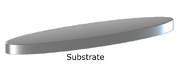
|
Film 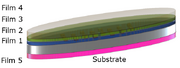
|
Traces 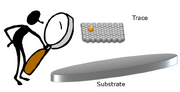
|
Miscellaneous 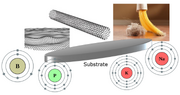
|
Examples:
|
Examples:
|
Examples:
|
Examples:
|
A film type is characterized by the material characteristics of any films on the given sample. A film need not be complete, a part does however need to be more than one atom thick and several nm wide in the plane – if it can be seen in a SEM it is probably a film – if it can be seen in a microscope it is definately a film. There can be more than one film. However, for some process, only the top layer might be important, if buried layers are not exposed during the process. Please contact the thinfilm group, if you have multilayer substrates and you are in doubt if you can process your sample.
How to Access the Cross Contamination Sheet
Attention: Please note that some cross contamination sheets might be outdated. If you are in doubt if you are allowed to process your wafer in a specific equipment, please contact training@nanolab.dtu.dk.
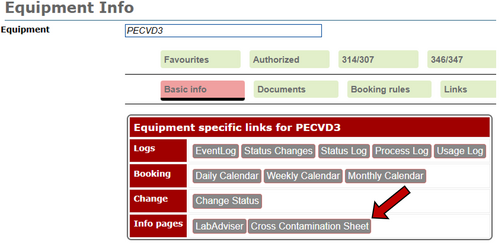
- Go to the “Equipment Info” page
- Select the tool
- Click on the button “Cross Contamination Sheet”
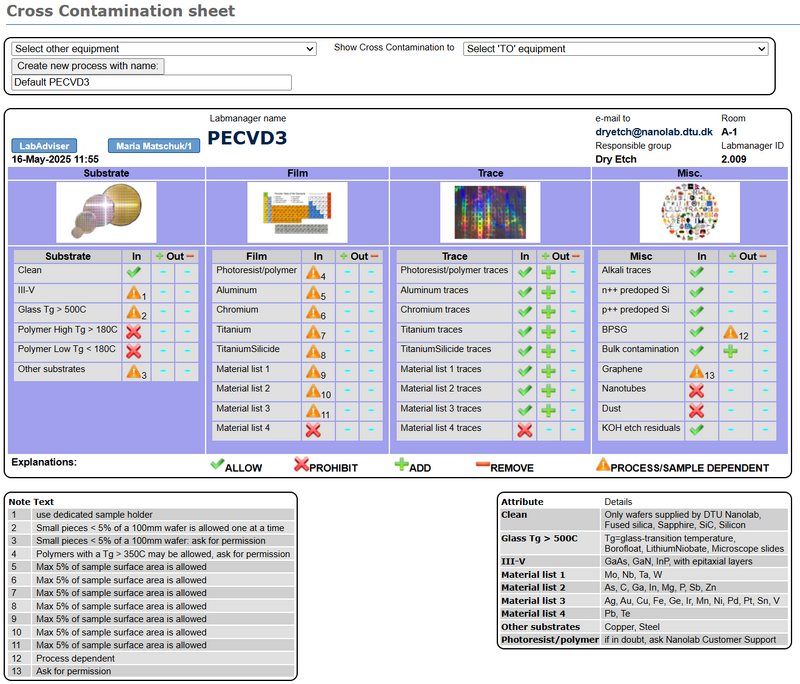
As you can see, there is a long list of substrates that can go into the "PECVD03", even with exposed metal films (area exposed < 5%), as long as they do not contain materials from "material list 4", nanotubes, or dust. Polymers are also not allowed in the equipment.
If you want to see the Cross Contamination between two Tools
- commonly the tool you selected is set as default, else click on "Select other equipment"
- click on "Select "TO" equipment"

As you can see from the overivew, it is not allowed to go with a sample processed in "PECVD03" to "Si Etch 1: KOH" (our cleanest KOH etch bath) as you sample - might - pick up contaminants of material list 3, such as silver, gold, or copper, and others in the PECVD03. Since those contaminants can alter the etching process and further contaminate samples processed in "Si Etch 1: KOH", they are forbidden.
How to use the system in LabManager
text
Why care about cross contamination?
text
The principle behind the Cross Contamination system.
text
An example – Details of the Cross Contamination sheet
text
How does it affect my work in the clean room?
text