
Specific Process Knowledge/Thermal Process/Oxidation: Difference between revisions
| Line 57: | Line 57: | ||
! | ! | ||
[[Specific_Process_Knowledge/Thermal_Process/C3_Anneal-bond_furnace|Anneal Bond furnace (C3)]] | [[Specific_Process_Knowledge/Thermal_Process/C3_Anneal-bond_furnace|Anneal Bond furnace (C3)]] | ||
! | |||
[[Al-Anneal furnace (C4)]] | |||
! | |||
[[Oxidation 8" (E1)]] | |||
! | ! | ||
[[Specific Process Knowledge/Thermal Process/Resist Pyrolysis furnace|Resist Pyrolysis furnace (research tool)]] | [[Specific Process Knowledge/Thermal Process/Resist Pyrolysis furnace|Resist Pyrolysis furnace (research tool)]] | ||
| Line 71: | Line 75: | ||
|Dry and wet oxidation of 100 mm and 150 mm wafers. Oxidation of new wafers without RCA cleaning. Oxidation and annealing of wafers from the LPCVD furnaces and PECVD4. | |Dry and wet oxidation of 100 mm and 150 mm wafers. Oxidation of new wafers without RCA cleaning. Oxidation and annealing of wafers from the LPCVD furnaces and PECVD4. | ||
|Dry and wet oxidation and annealing of wafers from Wafer Bonder 02 and from PECVD4 and PECVD3. | |Dry and wet oxidation and annealing of wafers from Wafer Bonder 02 and from PECVD4 and PECVD3. | ||
| | |||
| | |||
|Dry oxidation of silicon and annealing in N<sub>2</sub>. But the furnace is mainly being used for pyrolysis of different resists | |Dry oxidation of silicon and annealing in N<sub>2</sub>. But the furnace is mainly being used for pyrolysis of different resists | ||
|Rapid thermal processing: RTA (annealing), RTO (oxidation), RTN (nitridation) and RTH (hydrogenation). | |Rapid thermal processing: RTA (annealing), RTO (oxidation), RTN (nitridation) and RTH (hydrogenation). | ||
| Line 92: | Line 98: | ||
*Dry: O<sub>2</sub> | *Dry: O<sub>2</sub> | ||
*Wet: Bubbler | *Wet: Bubbler | ||
| | |||
* | |||
| | |||
* | |||
| | | | ||
*Dry: O<sub>2</sub> | *Dry: O<sub>2</sub> | ||
| Line 109: | Line 119: | ||
| | | | ||
*N<sub>2</sub> | *N<sub>2</sub> | ||
| | |||
*N<sub>2</sub> | |||
| | |||
* | |||
| | | | ||
*N<sub>2</sub> | *N<sub>2</sub> | ||
| Line 131: | Line 145: | ||
| | | | ||
*900 <sup>o</sup>C - 1150 <sup>o</sup>C | *900 <sup>o</sup>C - 1150 <sup>o</sup>C | ||
| | |||
* | |||
| | |||
* | |||
| | | | ||
*25 <sup>o</sup>C - 1050 <sup>o</sup>C | *25 <sup>o</sup>C - 1050 <sup>o</sup>C | ||
| Line 158: | Line 176: | ||
*1-30 50 mm wafers | *1-30 50 mm wafers | ||
*1-30 100 mm wafers | *1-30 100 mm wafers | ||
| | |||
* | |||
| | |||
* | |||
| | | | ||
*1-30 50 mm, 100 mm or 150 mm wafers per run | *1-30 50 mm, 100 mm or 150 mm wafers per run | ||
| Line 179: | Line 201: | ||
*All processed wafers have to be RCA cleaned, except wafers from LPCVD furnaces and PECVD4. | *All processed wafers have to be RCA cleaned, except wafers from LPCVD furnaces and PECVD4. | ||
| | | | ||
*All processed wafers have to be RCA cleaned, except for wafers from Wafer Bonder 02 and from PECVD4 and PECVD3. | *All processed wafers have to be RCA cleaned, except for wafers from Wafer Bonder 02 and from PECVD4 and PECVD3 | ||
| | |||
* | |||
| | |||
*. | |||
| | | | ||
*Only samples for resist pyrolysis, and all sample materials have to be approved by DTU Nanolab. Samples with metals and III-V materials are NOT allowed | *Only samples for resist pyrolysis, and all sample materials have to be approved by DTU Nanolab. Samples with metals and III-V materials are NOT allowed | ||
Revision as of 15:33, 21 March 2024
Feedback to this page: click here
Unless otherwise stated, this page is written by DTU Nanolab internal
Oxidation
At DTU Nanolab we have seven furnaces and one RTP (rapid thermal processors) which can be used for thermal oxidation of silicon samples: Boron Drive-in + Pre-dep furnace (A1), Gate Oxide furnace (A2), Phosphorous Drive-in furnace (A3), Anneal-oxide furnace (C1), Anneal-Bond furnace (C3), Al-Anneal furnace (C4), Oxidation 8" (E1), Resist Pyrolysis furnace and RTP Annealsys.
Thermal oxidation can take place either by a dry process or by a wet process, depending on what furnace that is used for the oxidation. The film quality for a dry oxide is better than the film quality for a wet oxide with regards to density and dielectric constant. However, the oxidation rate is slow for dry oxidation.
- Dry oxidation is used to grow 5 nm - 300 nm of oxide in the furnaces: A1, A2, A3, C1, C3, C4, E1 and Resist Pyrolysis furnaces.
- Wet oxidation is used to grow up to ~3 µm of oxide in the furnaces: A1, A3, C1, C3 and E1 furnaces.
Wafers with oxide layers thicker than >3 µm can normally not be made in the cleanroom and will have to be bought from somewhere else (but check the wafer shop first - there might be some on stock). It is NOT allowed to oxidize the same wafers two time to get a thicker layer than 3 µm without approval.
Thermal oxidation can done at temperatures up to 1050 C - 1150 C, depending on the furnace - and especially the diameter of the furnace tube. At these high temperatures, the quartz tube in the furnace might start to deform, so therefore the oxidation times are restricted:
- A1, A2, A3, C3 and C4 furnaces: Maximum allowed oxidation time at 1150 C: 8 hours
- A1, A2, A3, C1, C3, C3, E1 furnaces: Maximum allowed oxidation time at 1100 C: 23 hours (this will result in ~3 um wet oxide)
- Resist Pyrolysis furnace: Maximum allowed oxidation time at 1050 C: 3 hours
The standard recipes, quality control limits and results for the Boron Drive-in + Pre-dep furnace (A1) and the Phosphorus Drive-in furnace (A3) can be found here:
- Standard recipes, QC limits and results for the Boron Drive-in + Predep furnace (A1)
- Standard recipes, QC limits and results for the Phosphorus Drive-in furnace (A3)
The wet oxidation rates for the Anneal-Bond furnace (C1) can be found here:
Standard recipes in the oxidation furnaces
The steps in the standard oxidation recipes in the A-stack furnaces (A1, A2 and A3) and the C-stack furnaces (C1, C3 and C4) can be found here:
Comparison of the oxidation furnaces
| Generel description | Dry and wet oxidation. Boron pre-deposition and boron drive-in of boron are also done in the furnace. | Dry oxidation of gate oxide and other very clean oxides. | Dry and wet oxidation. Phosphorous drive-in is also done in the furnace. | Dry and wet oxidation of 100 mm and 150 mm wafers. Oxidation of new wafers without RCA cleaning. Oxidation and annealing of wafers from the LPCVD furnaces and PECVD4. | Dry and wet oxidation and annealing of wafers from Wafer Bonder 02 and from PECVD4 and PECVD3. | Dry oxidation of silicon and annealing in N2. But the furnace is mainly being used for pyrolysis of different resists | Rapid thermal processing: RTA (annealing), RTO (oxidation), RTN (nitridation) and RTH (hydrogenation). | ||
|---|---|---|---|---|---|---|---|---|---|
| Oxidation method |
|
|
|
|
|
|
|
|
|
| Annealing gas |
|
|
|
|
|
|
|
|
|
| Process temperature |
|
|
|
|
|
|
|
|
|
| Substrate and batch size |
|
|
|
|
|
|
|
|
|
| Allowed materials |
|
|
|
|
|
|
|
|
|
Oxidation curves
Color chart for oxide/nitride thickness
Generic calculator for wet/dry oxide thickness calculation
The following links give an approximate oxide time/thickness based on a general formula:
Deal-Grove parameters
By Kasper Reck-Nielsen February 2015
The following table contains linear and parabolic parameters for use in the Deal-Grove model for thermal oxidation. The parameters are obtained a least squares fit to data available in the furnace logbooks. Information on wafer orientation and doping concentration, which is not available in the logbooks, has not been included in calculating the parameters.
| Anneal Oxide | Anneal Bond | Boron Drive-in | Gate Oxide | Phosphor Drive-in | |||||||||||
|---|---|---|---|---|---|---|---|---|---|---|---|---|---|---|---|
| Recipe | B [µm2/h] | B/A [µm/h] | RMSE [nm] | B [µm2/h] | B/A [µm/h] | RMSE [nm] | B [µm2/h] | B/A [µm/h] | RMSE [nm] | B [µm2/h] | B/A [µm/h] | RMSE [nm] | B [µm2/h] | B/A [µm/h] | RMSE [nm] |
| DRY900 | 0.000408 | 0.107 | Too little data | 0.0660 | 0.272 | 31 | 0.000390 | 0.154 | Too little data | 0.0028 | 0.079 | 4 (limited data) | 0.0507 | 0.884 | Too little data |
| DRY1000 | - | - | - | - | - | - | 0.465 | 0.838 | 20 | - | - | - | 0.641 | 1.45 | 41 |
| DRY1050 | 0.0111 | 0.526 | 27 | - | - | - | 0.0129 | 0.330 | 8 | 0.022 | 0.505 | 3 (limited data) | 0.0134 | 0.362 | 6 |
| DRY1100 | 0.020 | 0.930 | 10 | - | - | - | 0.0212 | 0.736 | 23 | - | - | - | 0.0313 | 0.553 | 14 |
| WET950 | - | - | - | - | - | 0.0716 | 1.25 | 12 | - | - | - | 0.110 | 1.17 | 11 | |
| WET1000 | 0.192 | 1.54 | 44 | - | - | 0.192 | 1.80 | 29 | - | - | - | 0.195 | 2.49 | 22 | |
| WET1050 | 0.487 | 0.965 | 29 | 0.477 | 0.899 | Too little data | 0.455 | 1.33 | 16 | - | - | - | 0.448 | 1.73 | 12 |
| WET1100 | 0.580 | 1.43 | 8 | - | - | - | 0.519 | 1.186 | 3 | - | - | - | 0.403 | 9.05 | 7 |
Wet Oxidation on <100>
The curves below are based on measurements in our specific furnaces and give more accurate results. We will still recommend to make minimum one test run if the thickness is very important.
- Wet oxidation
-
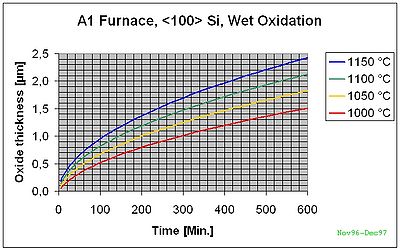 A1 Furnace <100>-Si Wet Oxidation
 -
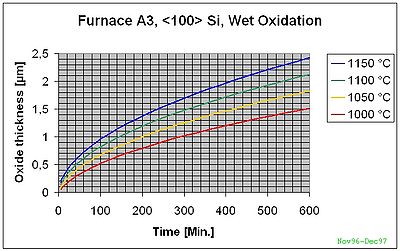 A3 Furnace <100>-Si Wet Oxidation


Dry Oxidation on <100> and <111> wafer
- Dry oxidation
-
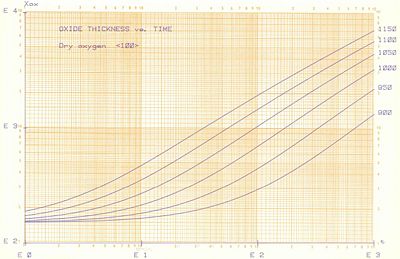 Dry oxide on <100> wafer. The y-axis is in Å and the x-axis is in minutes.
 -
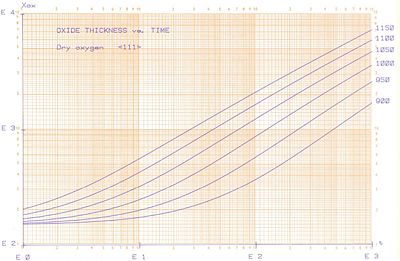 Dry oxide on <111> wafer. The y-axis is in Å and the x-axis is in minutes.


Breakdown voltage measurements
Breakdown measurements have been done for A1 Boron Drive-in/Pre-dep furnace, A2 Gate Oxide furnace and A3 Phosphorus drive-in furnaces in November 2021. For E1 Oxidation (8") furnace, it has been done in Febuary 2022. The results can be found on this page: