
Specific Process Knowledge/Characterization/XPS/XPS technique: Difference between revisions
| Line 18: | Line 18: | ||
; Transport towards the vacuum | ; Transport towards the vacuum | ||
: The inelastic mean free path of the photoelectrons is very short. The information carried by the photoelectrons will therefore quickly degrade as they collide inelastically and loose part of their energy. This means that only photoelectrons originating from the ~10 topmost atomic layers of the sample contribute to the signal - in this way making XPS extremely surface sensitive. The tail of former photoelectrons with non-specific energy is called the background. | : The inelastic mean free path of the photoelectrons is very short. The information carried by the photoelectrons will therefore quickly degrade as they collide inelastically and loose part of their energy. This means that only photoelectrons originating from the ~10 topmost atomic layers of the sample contribute to the signal - in this way making XPS extremely surface sensitive. The tail of former photoelectrons with non-specific energy is called the background. From inside the sample the electrons must pass the socalled work function in order to escape into the vacuum. | ||
; Detection in the analyzer | ; Detection in the analyzer | ||
: In the analyzer the electrons are separated according to the kinetic energy by two concentric spheres held at some potential. By playing on the acceptance angle of the entrance/exit slits of the analyzer one can tune the energy resolution with the parameter called pass energy. Subsequently detected by the spectrometer, the number of electrons may be plotted as a function of energy thus making up an XPS spectrum. | |||
Revision as of 15:42, 31 August 2015
Feedback to this page: click here
XPS technique
XPS is a surface sensitive and non destructive technique used for analysis of the elemental composition of a sample. The basic principle is shown below.
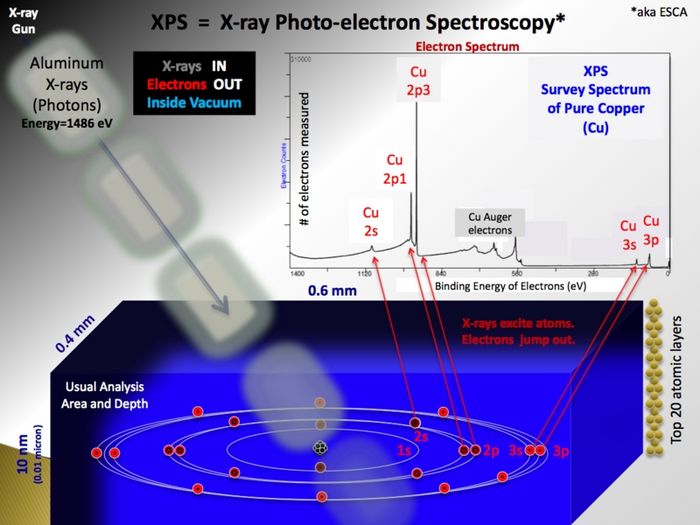
The analysis relies on the sequence:
- The X-ray source
- In the X-ray gun, electrons are extracted from a filament and accelerated by a high voltage onto an aluminium anode. Here, much like the primary beam in an SEM, X-rays with the characteristic energy of aluminium (1486.7 eV) are generated. Emitted isotropically, some X-rays hit a quartz crystal that act as monochromator as the X-rays diffract on the crystal planes according to the Bragg equation. If curved, the crystal will also focus the beam of X-rays and in this way enable us to use X-ray spots (in the shape of ellipses) of different sizes - ranging from 400 µm to 40 µm. The smaller spots, however, only come at the price of a drastically lowered intensity - therefore it is generally advised only to use the default value of 400 µm unless strictly necessary for some reason.
- Generation of photoelectrons
- As the incoming and monochromatic X-rays (with energy Ephot) impinge on and travel through the sample, they may react with electrons bound to atoms in the sample with a certain binding energy (Ebind). The result is free electron inside sample with a kinetic energy (Ekin=Ephot-Ebind) that is characteristic of the atomic level it originated from. As the binding energy depends on the small energy changes in the electronic states induced by the formation of chemical bonds, the electron also carries information about the chemical state.
- Transport towards the vacuum
- The inelastic mean free path of the photoelectrons is very short. The information carried by the photoelectrons will therefore quickly degrade as they collide inelastically and loose part of their energy. This means that only photoelectrons originating from the ~10 topmost atomic layers of the sample contribute to the signal - in this way making XPS extremely surface sensitive. The tail of former photoelectrons with non-specific energy is called the background. From inside the sample the electrons must pass the socalled work function in order to escape into the vacuum.
- Detection in the analyzer
- In the analyzer the electrons are separated according to the kinetic energy by two concentric spheres held at some potential. By playing on the acceptance angle of the entrance/exit slits of the analyzer one can tune the energy resolution with the parameter called pass energy. Subsequently detected by the spectrometer, the number of electrons may be plotted as a function of energy thus making up an XPS spectrum.