
Specific Process Knowledge/Thin Film deposition/ALD/TiO2 deposition using ALD: Difference between revisions
No edit summary |
|||
| Line 36: | Line 36: | ||
|} | |} | ||
===TiO<sub>2</sub> deposition rates=== | |||
====TiO<sub>2</sub> deposition rates==== | |||
In the graphs below the TiO<sub>2</sub> thickness as function of the number of cycles for deposition temperatures between 150 <sup>o</sup>C and 350 <sup>o</sup>C can be seen. From the equations the number of cycles required for a certain thickess to be deposited can be calculated. All results have been obtained for Si wafers with native oxide. | In the graphs below the TiO<sub>2</sub> thickness as function of the number of cycles for deposition temperatures between 150 <sup>o</sup>C and 350 <sup>o</sup>C can be seen. From the equations the number of cycles required for a certain thickess to be deposited can be calculated. All results have been obtained for Si wafers with native oxide. | ||
| Line 46: | Line 47: | ||
</gallery> | </gallery> | ||
===TiO<sub>2</sub> results=== | ====TiO<sub>2</sub> results==== | ||
Some some SEM images of TiO<sub>2</sub> deposited on a Si surface at different temperatures between 150 <sup>o</sup>C and 350 <sup>o</sup>C are shown below. Some of samples have been treated with HF (hydrofluoric acid) to remove the native oxide layer just before the ALD deposition. | Some some SEM images of TiO<sub>2</sub> deposited on a Si surface at different temperatures between 150 <sup>o</sup>C and 350 <sup>o</sup>C are shown below. Some of samples have been treated with HF (hydrofluoric acid) to remove the native oxide layer just before the ALD deposition. | ||
Revision as of 11:53, 3 July 2015
THIS PAGE IS UNDER CONSTRUCTION

Feedback to this page: click here
The ALD window for titanium dioxide (TiO2) ranges from 120 oC to 350 oC.
A low temperatures between 120 oC and 150 oC an amorphous TiO2 layer is grown in the ALD, and at higher temperatures between 300 oC and 350 oC an anatase TiO2 layer is grown. At temperatures between 150 oC and 300 oC the TiO2 layer will be a mixture of both amorphous and anatase TiO2.
For Si wafers, amorphous TiO2 is best grown on wafers with native oxide, and anatase TiO2 is best grown on wafers without native oxide (removed using HF).
TiO2 standard recipe
Recipe: TiO2
Temperature: 120 oC - 350 oC
| TiCl4 | H2O | |
|---|---|---|
| Nitrogen flow | 150 sccm | 200 sccm |
| Pulse time | 0.1 s | 0.1 s |
| Purge time | 3.0 s | 4.0 s |
TiO2 deposition rates
In the graphs below the TiO2 thickness as function of the number of cycles for deposition temperatures between 150 oC and 350 oC can be seen. From the equations the number of cycles required for a certain thickess to be deposited can be calculated. All results have been obtained for Si wafers with native oxide.
- Titanium dioxide thickness as function of number of cycles
-
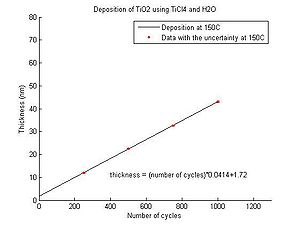 Temperature 150 oC.
 -
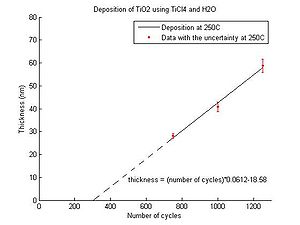 Temperature 250 oC.
 -
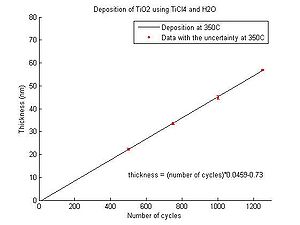 Temperature 350 oC.


TiO2 results
Some some SEM images of TiO2 deposited on a Si surface at different temperatures between 150 oC and 350 oC are shown below. Some of samples have been treated with HF (hydrofluoric acid) to remove the native oxide layer just before the ALD deposition.
- Titanium dioxide deposited at different temperatures on a Si surface
-
 Temperature 150 oC, 1200 cycles, HF treated.
 -
 Temperature 150 oC, 1200 cycles.
 -
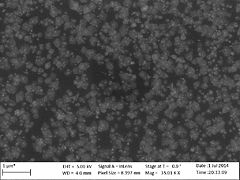 Temperature 250 oC, 750 cycles.


-
 Temperature 300 oC, 1000 cycles, HF treated.
 -
 Temperature 300 oC, 1000 cycles.
 -
 Temperature 350 oC, 1250 cycles, HF treated.


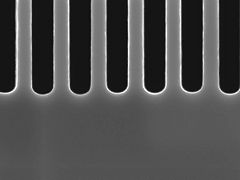
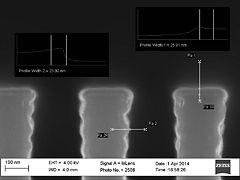
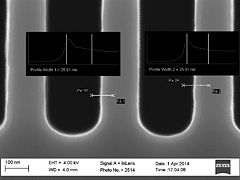
Below some SEM images of amorphous TiO2 deposited at 120 oC on Si trenches are shown. The width of the trenches is 200 nm, and the depth is 4 µm, i.e. the aspect ratio is 1:20. The number of cycles is 500, and this results in a TiO2 layer of about 25 nm. From the SEM images it is seen that the TiO2 layer covers the trenches very well.
- Amorphous titanium dioxide deposited on Si trenches
-
-
-


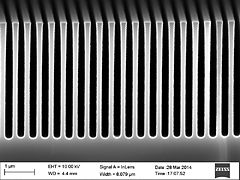
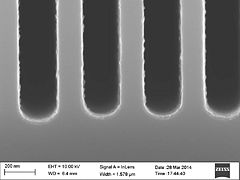
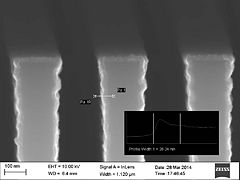
Below some SEM images of anatase TiO2 deposited at 300 oC on Si trenches are shown. The width of the trenches is 200 nm, and the depth is 4 µm, i.e. the aspect ratio is 1:20. The number of cycles is 500, and this results in a TiO2 layer of about 26 nm. From the SEM images it is seen that the TiO2 layer covers the trenches very well.
- Anastase titanium dioxide deposited on Si trenches
-
-
-


XPS measurements of TiO2 deposited at 120 oC and 300 oC are shown below. From the XPS measurements it can be calculated that at temperatures below 120 oC the TiO2 layer will be contaminated with about 1-3 % chlorine molecules from the TiCl4 precursor. This can be also seen as small white dots in the SEM image of the amorphous TiO2 layers above.

Evgeniy Shkondin, DTU Danchip, 2014.