Specific Process Knowledge/Polymer Processing/PDMS Post-processing: Difference between revisions
Created page with " The fabrication of microfluidic devices requires further processing of PDMS, including cutting, creating through-holes, bonding to other parts, and surface functionalization. 1000px|frame|center|Fabrication of microfluidic device by casting of PDMS on SU-8/silicon mould, folowed by punching of through holes, and glass, vial bonding ==Cutting of PDMS== Cutting of PDMS is a common step in the fabrication of PDMS microfluidics to create..." |
No edit summary |
||
| Line 1: | Line 1: | ||
The fabrication of microfluidic devices requires further processing of PDMS, including cutting, creating through-holes, | The fabrication of PDMS microfluidic devices requires further processing of PDMS once it has been casted and cured, including cutting, creating through-holes, | ||
bonding to other parts, and surface functionalization. | bonding to other parts, and surface functionalization. Details on PDMS casting are described in [https://labadviser.nanolab.dtu.dk//index.php?title=Specific_Process_Knowledge/Polymer_Processing/PDMS_Casting PDMS Casting] | ||
[[File:Processing of PDMS .png|1000px|frame|center|Fabrication of microfluidic device by casting of PDMS on SU-8/silicon mould, folowed by punching of through holes, and glass, vial bonding]] | [[File:Processing of PDMS .png|1000px|frame|center|Fabrication of microfluidic device by casting of PDMS on SU-8/silicon mould, folowed by punching of through holes, and glass, vial bonding]] | ||
[[File:PDMS lab process.jpg|center|frame|Process for PDMS in DTU Nanolab, work done by Claudia Chaves Villarreal cchvi@dtu.dk]] | |||
==Cutting of PDMS== | ==Cutting of PDMS== | ||
Latest revision as of 11:21, 5 November 2026
The fabrication of PDMS microfluidic devices requires further processing of PDMS once it has been casted and cured, including cutting, creating through-holes, bonding to other parts, and surface functionalization. Details on PDMS casting are described in PDMS Casting


Cutting of PDMS
Cutting of PDMS is a common step in the fabrication of PDMS microfluidics to create access ports, also known as througholes, or for separating the individual devices from a microfluidic PDMS wafer. The PDMS lab thrives on providing the optimal tools and processes for the users. Common tools that are provided in the lab for manual cutting are tweezers, blades, cutting mats, light screen and press.
Alternative methods for high-throughput fabrication are under investigation at Nanolab to meet the demands of the industry and large interdisciplinary projects. The cutting methods being researched include the development of wafer-size punching, laser ablation, mechanical and air/water jet machining.
Punching

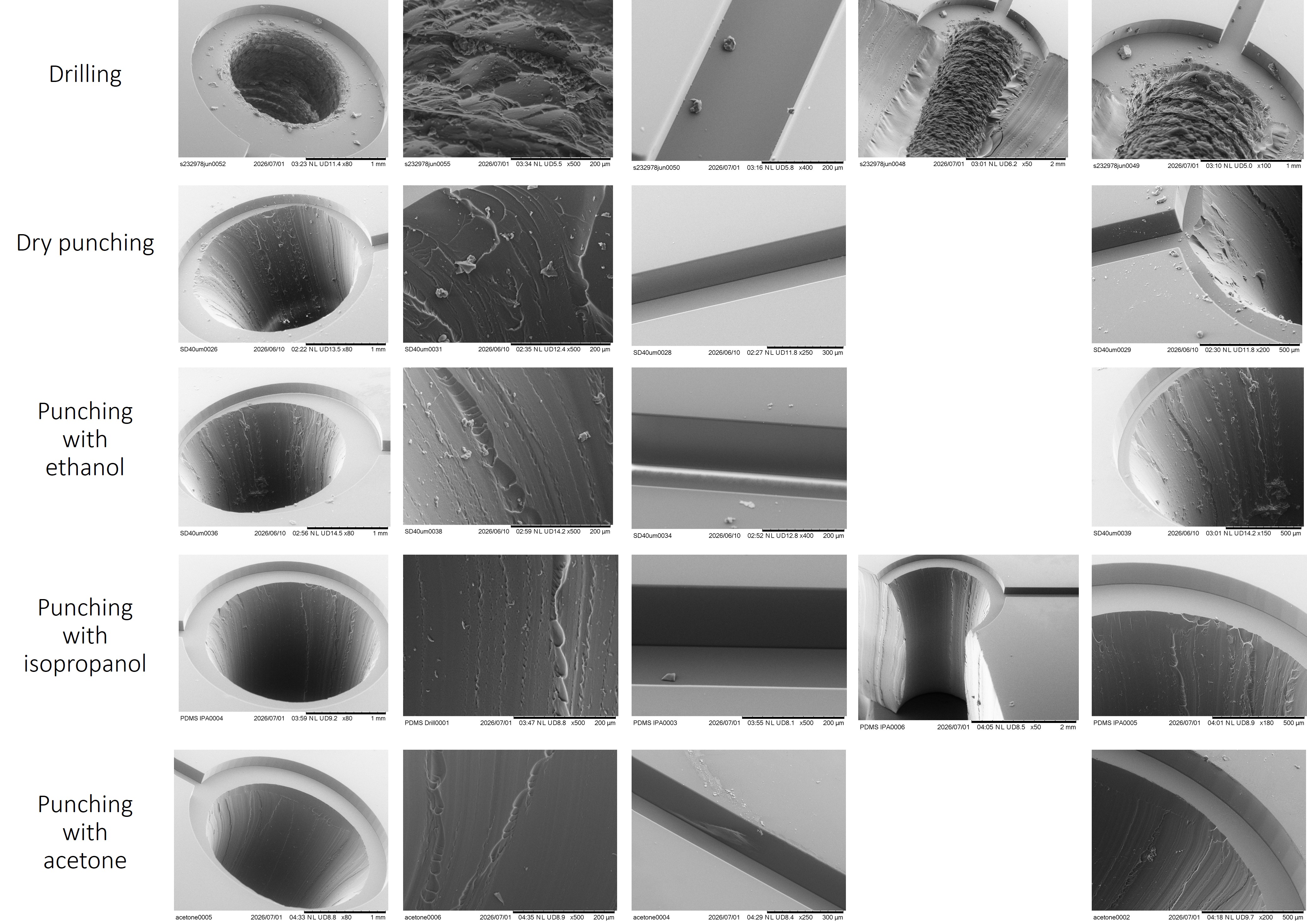
The access ports of microfludic devices, also known as through-holes, can be created using manual punchers commercially available for biopsy or general use. Always punch the devices on top of the green cutting board to extend the lifetime of the puncher blade and to avoid marking the table. Solvents like ethanol, isopropanol and acetone can be used as lubricants to facilitate the cutting and result in a cleaner surface. All solvents must be always used inside the fume hood. The resulting punched holes in PDMS tend to be slightly smaller than the puncher diameter, smo, the final dimensions of the holes must be confirmed with metrology methods.
Laser ablation
The ultra short pulsed laser (pisecond to femtosecond) can be used as a "cold machining" approach to cut transparent dielectrics like PDMS. At DTU Nanolab, the Laser Micromachining Tool can be used for processing PDMS.
Machining/milling
Air/water jet machining
3D printing of PDMS
Soft-litography micromolding and cutting protocols pose limitations for complex designs, require long processing times, and are labour intensive. 3D printing of PDMS provides the automation and versatility features to meet the demands for future technologies. The 3D printing of PDMS is currently under development at Nanolab.
PDMS cleaning

The processing of PDMS may contaminate its surface yielding it inadequate for its final application, or affecting its surface for further bonding. Cutting with sharp tools like puncher and milling may leave reasidues of PDMS particles and lubricants. Laser ablation may leave silicone powder, carbon, ashes, and further by-products of the thermal decomposition. The manipulation may also contaminate it with grease or particles from the environment.
PDMS surface modification
Different physical and chemical treatments can modify the wettability, refractive index, and light propagation of PDMS, due to both chemical bond rearrangements and changes in surface roughness.
Chemical treatment
Laser treatment
Bonding of PDMS
In many applications, including microfluidics, it is necessary to bond the PDMS microfluidic chips to glass, PMMA, other PDMS parts and more. In this section we describe the methods so far used for creating stron, long-lasting bonds.
Bonding of PDMS to glass and other PDMS parts


Oxygen plasma treatment of PDMS and glass surfaces can be used for bonding. The plasma induces activation of Si-O-H groups in the surface of glass and PDMS, which induces a strong bond when the surfaces are shortly brought into contact. The plasma equipment requires to login in LabManager, after proper training by Nanolab staff.
The modified surface will fastly recover its hydrophobic structure. Therefore, the treated surfaces must be brought into contact immediately after the plasma had been applied.
A press is available in the lab to hold parts under pressure after brought into contact to reinforce the bonding.
The oxygen plasma treatment to apply must be optimized for the specific surfaces to be bonded. If the exposure is too short, not enough Si-OH sites might be created for good bonding. If the exposure is too long, too many Si-OH and roughness might result in a non-sticking silica layer.
The standard conditions for bonding PDMS and glass in the system at the PDMS lab at DTU Nanolab have been found to be:
- Pressure: 0.35 mTorr
- Oxygen flow: 100% (5-6sccm)
- Power: 100%
- Time: 30 s
The plasma treatment above described does not induce any permanent chemical modification to the glass or PDMS, as demonstrated by XPS analysis.


Bonding of PDMS to PMMA
PDMS can be bonded to other polymers, like PMMA, for interfacing the microstructured patterns with tubes, vials and other macroscopic parts. The Sylgard 184 elastomer kit can be used as a "glue" between PMMA and cured PDMS, provided that an extended curing time of 24 hours at 70°C is applied to create a robust bond between the two surfaces. Roughening the PMMA surface beforehand may result in stronger adhesion.
The standard conditions for PMMA treating before confing to PDMS in the system at the PDMS lab at DTU Nanolab have been found to be:
- Pressure: 0.35 mTorr
- Oxygen flow: 100% (5-6sccm)
- Power: 100%
- Time: 120 s
Contact and access
For further information contact PolyFablLab