
Specific Process Knowledge/Characterization/MicroSpectroPhotometer (Craic 20/30 PV): Difference between revisions
| Line 69: | Line 69: | ||
To create an absorption spectrum from two single-beam spectra, you can use the following formula: | To create an absorption spectrum from two single-beam spectra, you can use the following formula: | ||
<math>A=-\log\frac{S-D}{R-D}</math> | |||
In this formula, R represents the single-beam spectrum of the reference material, S represents the single-beam spectrum of the sample, and D represents the dark counts of the system. | In this formula, R represents the single-beam spectrum of the reference material, S represents the single-beam spectrum of the sample, and D represents the dark counts of the system. | ||
| Line 76: | Line 76: | ||
Alternatively, you can generate an absorption spectrum from transmission data using the following formula: | Alternatively, you can generate an absorption spectrum from transmission data using the following formula: | ||
<math>A=2-\log(T(\%))</math> | |||
This formula allows you to convert percent transmittance (%T) values into absorbance. It is particularly useful for processing data that has already been collected | This formula allows you to convert percent transmittance (%T) values into absorbance. It is particularly useful for processing data that has already been collected | ||
Revision as of 14:36, 27 September 2023
Feedback to this page: click here
Unless otherwise stated, all content on this page was created by Evgeniy Shkondin (DTU Nanolab)
All images and photos on this page belongs to DTU Nanolab.
Microspectrophotometer (Craic 20/30 PV)
- Microspectrophotometer.
-
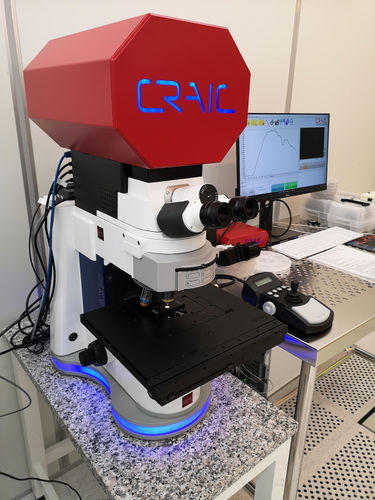 Craic 20/30 PV.

We acquired a microspectrophotometer, the CRAIC 20/30 PV, in 2021. This advanced instrument is designed for precise measurements of reflectance, transmission, and absorbance of thin films and microstructures within the UV/Visible/NIR wavelength range, spanning from 480nm to 1698nm.
This microspectrophotometer boasts two dedicated spectrometers: one for UV-Visible (200-900nm) and another for NIR (900-2230nm). It delivers exceptional spectral resolution, with 0.5 nm for the UV/Visible detector and 3.0 nm for the NIR detector. Importantly, the system allows for the separate storage of measured spectra and offers customizable merging of the two spectra.
Equipped with two objectives, a 10x quartz objective (wavelength range 220 nm to 2100 nm, NA 0.2, WD 7.4 mm) and a 40x quartz objective (wavelength range 240 nm to 2100 nm, NA 0.6, WD 0.36 mm), this tool provides versatility for various applications. Six aperture sizes, ranging from 100.2 to 1.5 microns, can be selected depending on the objective, facilitating the characterization of micro- and nanostructures' optical properties.
For polarization measurements, polarizers and analyzers can be installed as needed. An intriguing feature is the motorized stage, offering a generous movement range of 114 mm by 75 mm, with a precise 0.02 µm step size. This enables comprehensive sample mapping.
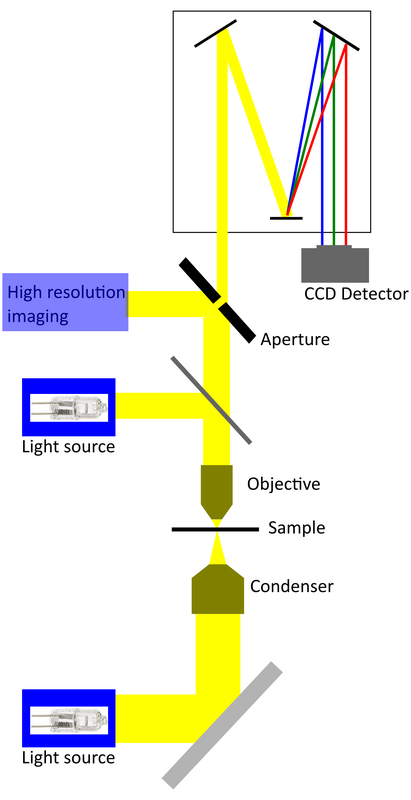
The microspectrophotometer operates as follows: A microscope-mounted lamp emits white light focused onto the sample. The sample selectively absorbs specific wavelengths, dependent on its chromophore's chemical structure and environment. Unabsorbed light is collected by the microspectrophotometer objective, focused onto the spectrophotometer's entrance aperture. The mirrored aperture reflects most of the light into a digital imaging system, simplifying alignment and spectrum acquisition.
The remaining unreflected light passes through the aperture into the spectrophotometer, where an optical grating separates it into component wavelengths. These wavelengths are measured by a pixel on a Charge Coupled Device (CCD) detector. The data is stored and presented as an optical spectrum, visualized as an XY chart displaying intensity at each wavelength.
Various microspectroscopy techniques are employed based on sample characteristics. For instance, opaque samples are analyzed with incident or reflectance illumination, while transparent samples are examined using transmitted light. Our microspectrophotometer can be configured to measure transmission, absorbance, and reflectance spectra.
Operation is straightforward: First, a dark scan measures system dark counts. Then, a reference material's spectrum is collected, encompassing spectral characteristics of the reference material, light sources, optics, and the CCD. Finally, the sample's spectrum is acquired, and an algorithm calculates the appropriate spectra for the specific lighting conditions (e.g., reflectance spectra for incident illumination). This algorithm is applied automatically, with the result displayed as a spectrum.
In summary, our CRAIC 20/30 PV microspectrophotometer empowers precise and versatile spectral measurements across a wide wavelength range, catering to a broad spectrum of research needs.
Work principle
- Microspectrophotometer.
-
 Craic 20/30 PV.

Reflectance Calculation
Reflectance calculation involves the generation of a reflectance spectrum, which can be derived from either sample and reference single-beam spectra or from a log 1/R spectrum.
From Two Single-Beam Spectra: To create a reflectance spectrum from two single-beam spectra, you can use the following formula:
In this formula, R represents the single-beam spectrum of the reference material, S represents the single-beam spectrum of the sample, and D represents the dark counts of the system.
Transmittance Calculation
Transmittance calculation involves generating a transmission spectrum by comparing two single-beam spectra: one from the sample and the other from the reference.
This is accomplished using the following formula:
In this formula, R represents the single-beam spectrum of the reference material, S represents the single-beam spectrum of the sample, and D represents the dark counts of the system.
The transmission spectrum can be computed based on the absorbance data using the following formula:
Here, A represents the absorbance value, which is derived from previously gathered data.
Absorbance Calculation
Absorbance calculation involves the generation of an absorption spectrum, which can be derived either from sample and reference single-beam spectra or from a transmission spectrum.
From Two Single-Beam Spectra: To create an absorption spectrum from two single-beam spectra, you can use the following formula:
In this formula, R represents the single-beam spectrum of the reference material, S represents the single-beam spectrum of the sample, and D represents the dark counts of the system.
From Transmission Data: Alternatively, you can generate an absorption spectrum from transmission data using the following formula:
This formula allows you to convert percent transmittance (%T) values into absorbance. It is particularly useful for processing data that has already been collected